The cheapest EV charging software quote is often not the lowest-cost option in production. CPOs should compare pricing model, integration cost, migration risk, support dependency, and data lock-in together.
What does EV charging software pricing actually include?
EV charging software pricing is the total cost to adopt, operate, integrate, and eventually change a platform, not the per-charger rate on the first quote. The headline number is the easiest part to compare and the least predictive of what you actually pay in production.
When CPOs ask for EV charging software pricing, many vendors respond with a clean number:
- price per charger
- price per connector
- platform fee per month
- pilot setup fee
Those numbers matter, but they rarely describe the full operating cost.
The real pricing question is:
What will this platform cost us to adopt, operate, integrate, and eventually change?
That is the level where pricing becomes a buying decision instead of a sales comparison.
Common EV charging software pricing models
Most EV charging software pricing falls into four shapes: per-charger, per-connector, flat platform or site fee, and usage-based. Each one bills you on a different unit, so each one hides cost in a different place. The model that looks cheapest on a spreadsheet is usually the one whose hidden costs are least visible to your specific fleet shape.
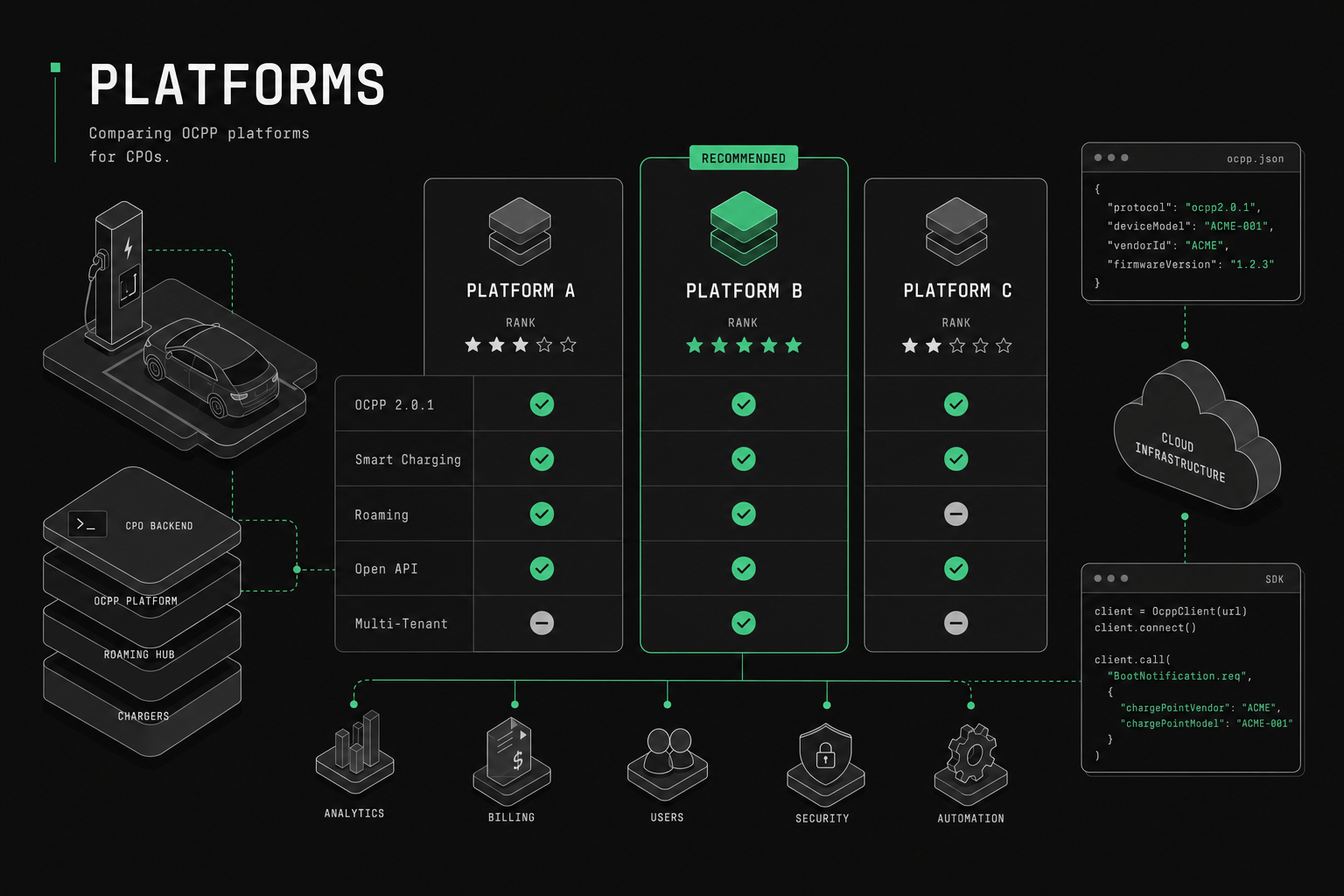
Before the model-by-model detail, the matrix below maps each pricing model against the cost categories it tends to obscure. Use it to decide which follow-up questions actually matter for your fleet, whether that fleet skews AC, DC, roaming-heavy, or migration-bound. For deeper context on how protocol choices drive these costs, see the OCPP platform pillar.
| Pricing model | Bills on | Where cost usually hides | Highest-risk fleet shape |
|---|---|---|---|
| Per-charger | Each provisioned charger | Dual-connected and staged-migration chargers counted twice | Phased migrations and large rollouts |
| Per-connector | Each connector | Idle connectors billed before a site is live | High-density DC sites |
| Platform / site fee | Flat monthly tier | Roaming, APIs, reporting, and support sold as add-ons | Fleets needing OCPI roaming or custom integrations |
| Usage / transaction | Sessions, CDR volume, or energy | Cost scales up as utilization improves | High-utilization, growing networks |
1. Per-charger pricing
This is common and easy to understand, but it can become expensive at fleet scale and may not reflect operational complexity fairly.
Questions to ask:
- Does the fee apply to active chargers only or every provisioned charger?
- What happens during pilot rollout or phased migration?
- Are dual-connected or staged-migration chargers counted twice?
2. Per-connector pricing
This can look cheaper for AC fleets and more expensive for high-density DC sites.
Questions to ask:
- Are connectors billed even when the site is not yet operational?
- Are connector upgrades or topology changes treated as commercial changes?
3. Platform or site fee
This can make sense for more stable fleets, but you still need to understand what is included.
Questions to ask:
- Is roaming included?
- Are APIs included?
- Are advanced routing, reporting, or support tiers separate?
4. Usage-based or transaction-based pricing
Some vendors tie pricing to charging sessions, CDR volume, energy, or payment flow.
This can align vendor revenue to fleet activity, but it can also create margin pressure when utilization improves.
Questions to ask:
- Does higher utilization make the software disproportionately more expensive?
- Are roaming sessions priced differently?
- How are refunds, failed sessions, or split workflows handled?
What hidden costs do EV charging software buyers miss?
The costs that move a deal are rarely on the rate card: migration effort, integration work, support escalation, and exit friction. These line items live in implementation services and contract terms, not the price-per-charger field, which is exactly why two quotes with identical headline rates can differ by a wide margin in production.
Migration cost
If the platform requires a hard cutover, the software quote may hide the real migration cost:
- charger reconfiguration
- field support coordination
- rollback planning
- parallel system operation
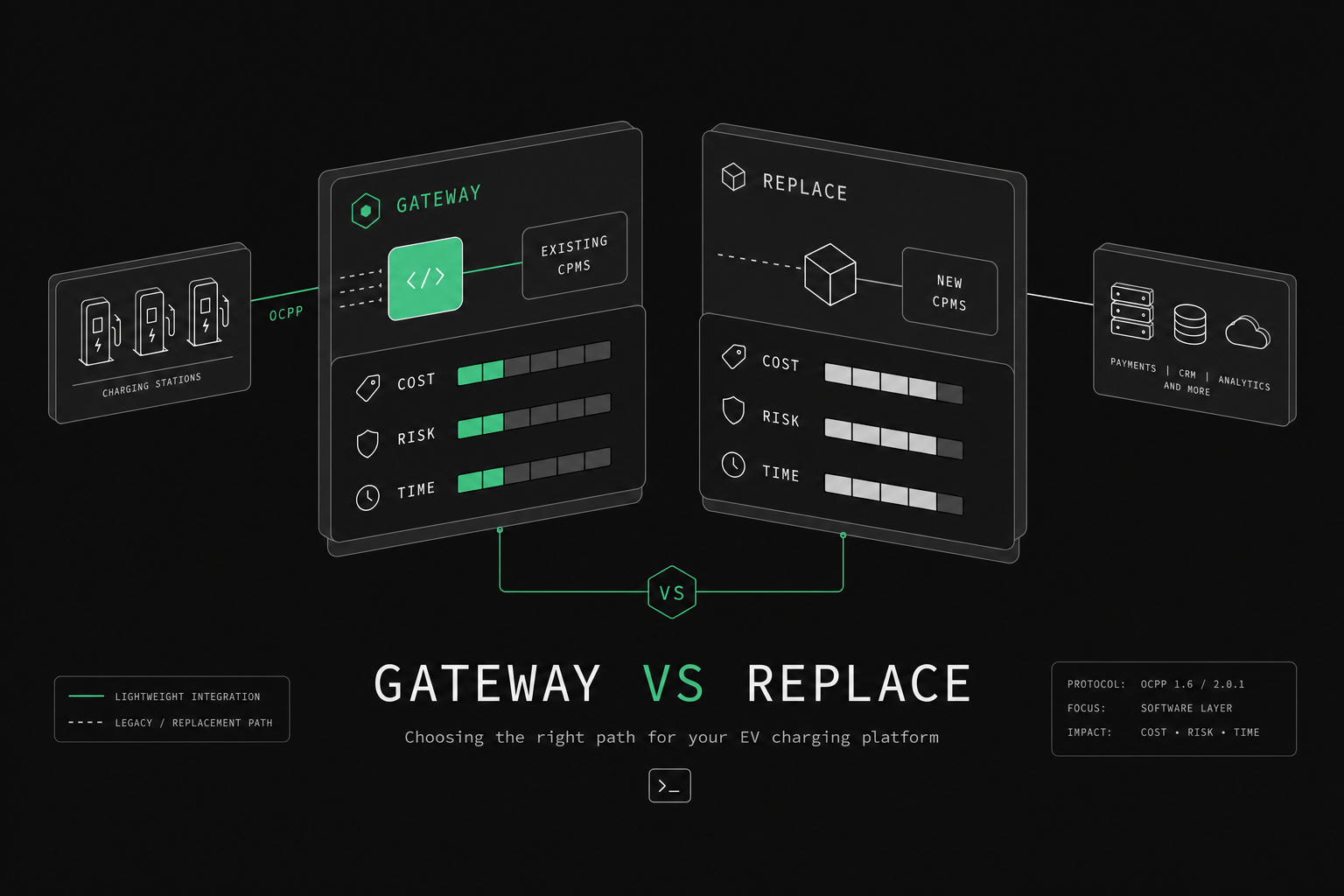
In mixed-fleet rollouts, the cost usually shows up as field time: someone has to point each charger at the new backend, confirm it boots and authorizes, and keep the old system reachable until every site is verified. A staged approach using an OCPP gateway can spread that work out instead of forcing a single risky cutover. The cheaper quote can become the more expensive project.
Integration cost
The commercial proposal may exclude:
- OCPI roaming setup
- billing or CRM integration
- webhook or API customization
- reporting exports
This matters because many CPOs do not buy a standalone CPMS. They buy a platform that has to fit the rest of the business. OCPI roaming setup is a frequent surprise here: a quote that omits hub onboarding, CDR reconciliation, and token handling can understate the true integration cost of going live with partners.
Support and escalation cost
Support models can distort total price more than the base fee.
Questions to ask:
- Is production support included?
- What SLA level is default?
- Is charger troubleshooting a paid services layer?
- Are firmware incidents and vendor quirks covered?
Data access and exit cost
This is a pricing issue, not only an architecture issue.
If data export, event access, or migration support are constrained, your future switching cost increases. That switching cost is part of the platform price even if it does not appear on the first proposal. This is fundamentally a question of data ownership: if you cannot export sessions, CDRs, and raw OCPP events on demand, the vendor effectively prices your exit for you.
How should CPOs compare EV charging software vendors?
Compare a full operating scenario, not a single quote. The fair way to evaluate EV charging software pricing is to model the same fleet across three moments in its life: launch, steady-state production, and the point where you need to change or leave. A vendor that wins on the pilot can lose badly on the third.
Use three scenarios, not one:
Scenario 1: Pilot
Model the first 30 to 90 days.
Questions:
- what do we pay to launch?
- what is included in onboarding?
- how much professional services time is required?
Scenario 2: Steady-state production
Model one year of normal operations.
Questions:
- what do we pay at target charger volume?
- what is the cost of integrations, roaming, support, and reporting?
- what changes when the fleet doubles?
Scenario 3: Change or exit
Model the moment the platform relationship gets hard.
Questions:
- what does migration away from this vendor look like?
- what data can we export?
- what is the cost of running in parallel during transition?
If a pricing comparison does not include scenario 3, it is not a serious procurement exercise.
When is a more expensive platform actually cheaper?
A higher software fee can still be the cheapest total option when it removes risk and rework elsewhere. The savings show up off the rate card: faster rollout, lower migration risk, fewer paid integrations, and a cleaner exit. Total cost of ownership, not the unit price, decides which vendor is actually cheaper.
A platform with a slightly higher software fee may still be the lower-cost option if it:
- shortens rollout time
- reduces migration risk
- preserves data portability
- lowers integration dependency
- avoids a full rip-and-replace project
This is why architectural fit and pricing should be evaluated together.
Where ev-cloud fits
ev-cloud is designed for teams that want pricing clarity without giving up architectural flexibility.
It is especially relevant when buyers want:
- phased migration instead of a risky cutover
- open OCPP and OCPI infrastructure
- multi-backend routing
- stronger control over data and event flows
That does not make every modular architecture cheaper on day one. It often makes the platform relationship safer and more economical over the life of the fleet.
Next buying step
Use this page together with:
- The EV charging software RFP template to structure vendor questions.
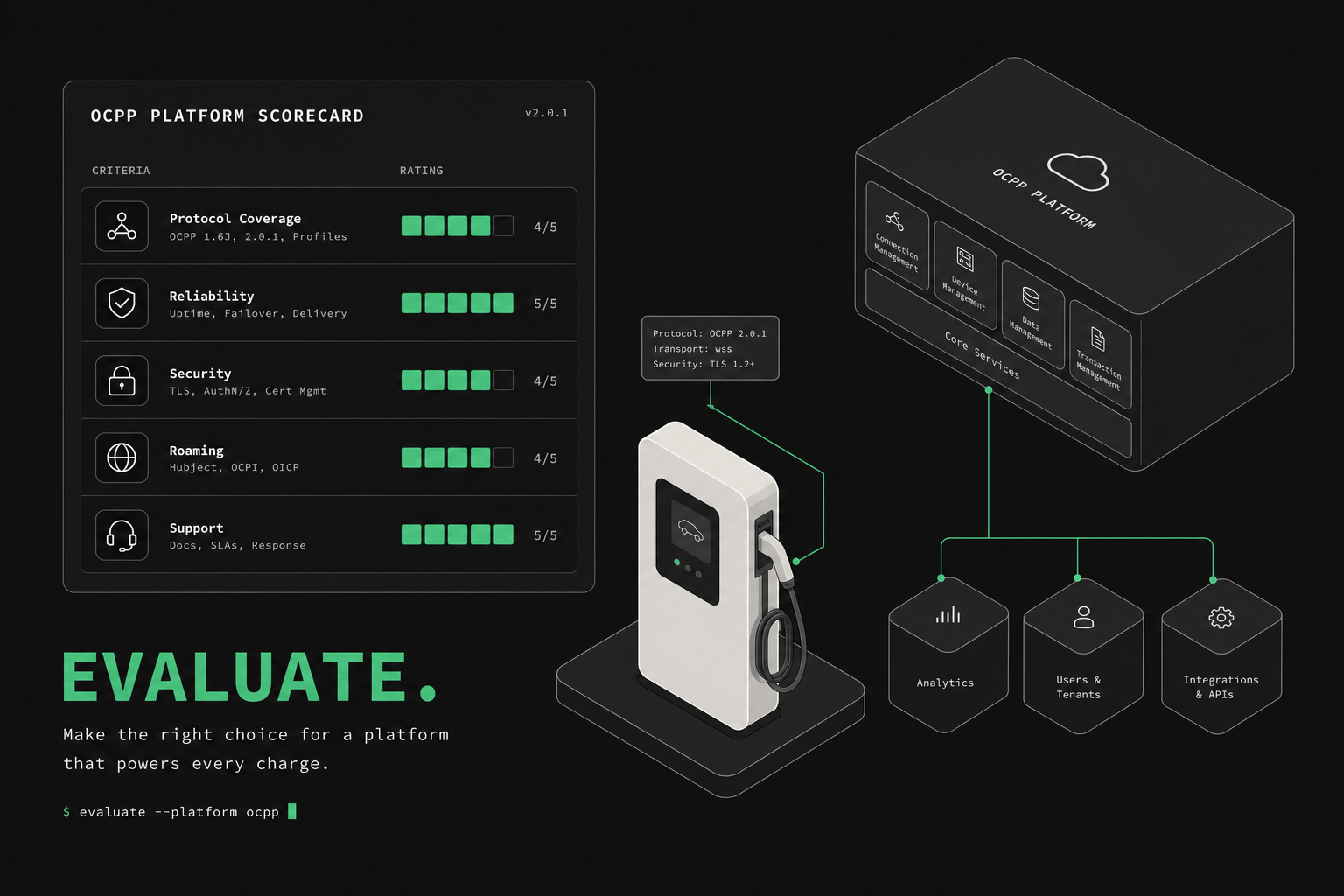
- The OCPP platform scorecard to compare flexibility and lock-in risk.
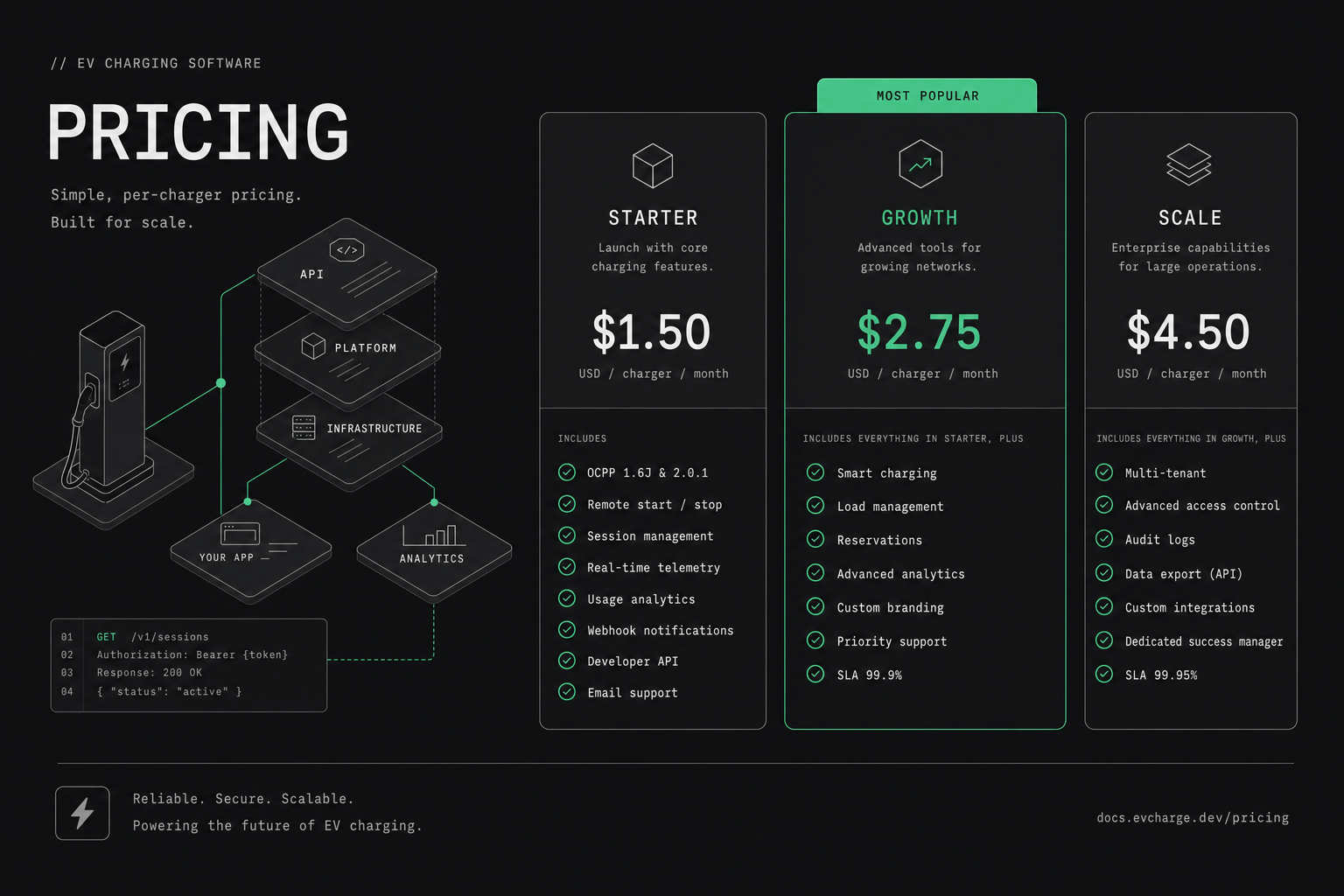
- The pricing page if you want to move from research into rollout scope and commercial fit.
When you are ready to pressure-test a quote against your real fleet shape, talk to our team and walk through the pilot, steady-state, and exit scenarios together.