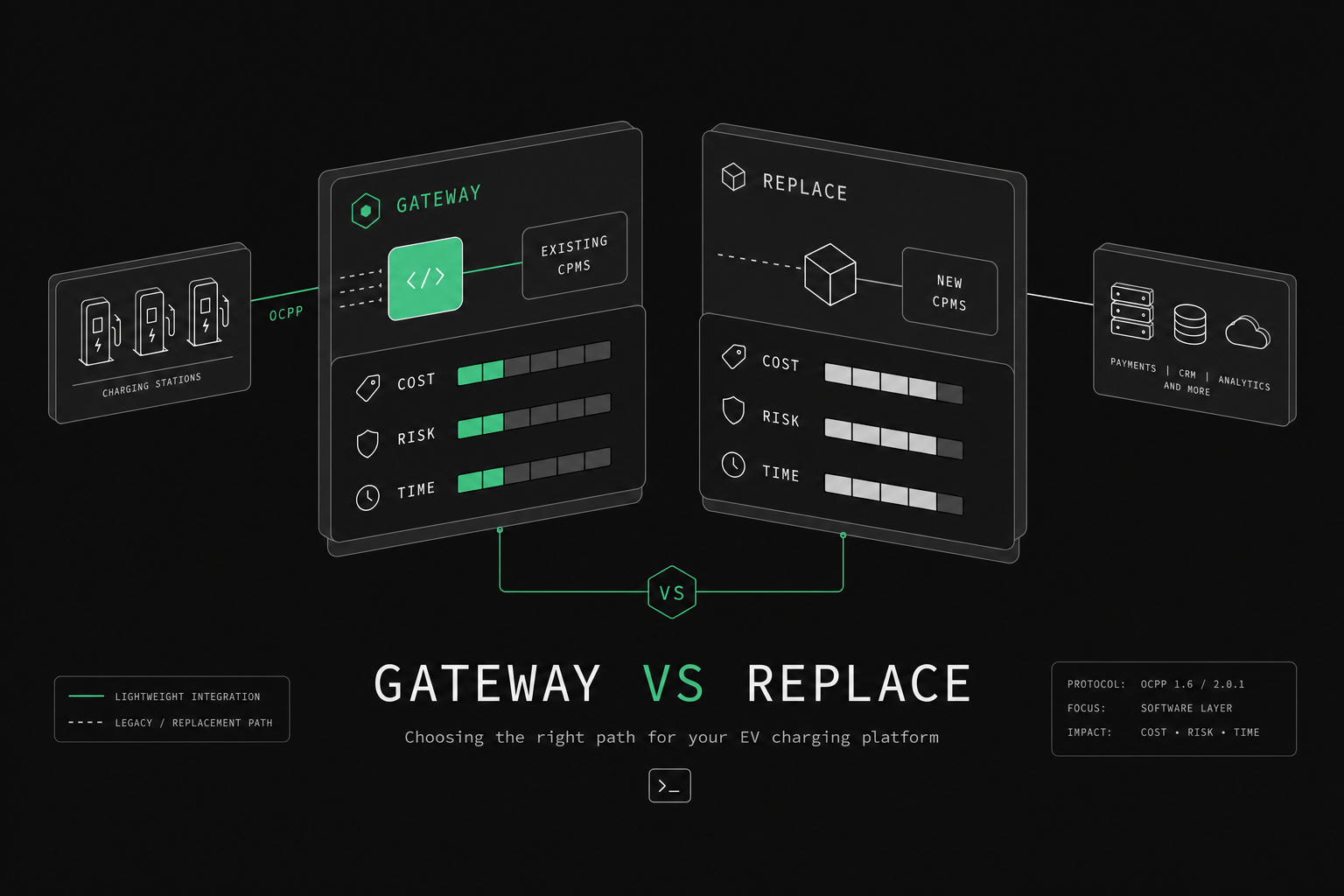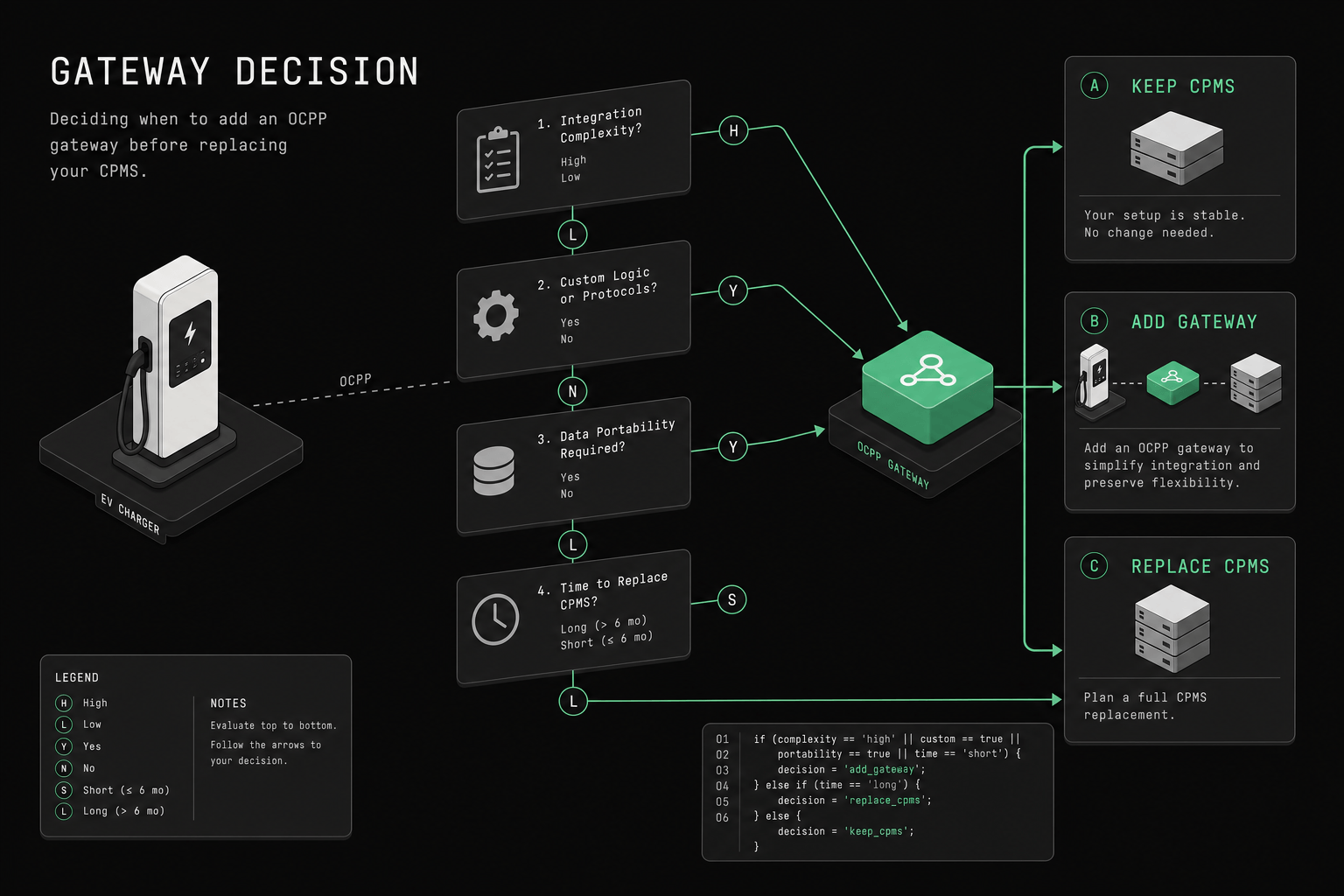
Add an OCPP gateway or OCPP proxy before a CPMS swap when phased migration, mixed fleets, multi-backend routing, or data ownership risk outweigh the cost of one extra infrastructure hop.
When does an OCPP gateway belong between chargers and your CPMS?
Add an OCPP gateway—buyers often call the multi-backend form an OCPP proxy—when the risk of migrating chargers directly onto a new CPMS is higher than the cost of running one more layer in the stack. In clean greenfield environments you usually do not need it. The gateway earns its place when migration gets messy.
Most real CPO environments are not clean. They carry multiple charger vendors, inconsistent firmware behavior, existing roaming and billing integrations, internal tooling built around the current platform, and a commercial obligation to migrate without dropping live sessions. Each of those is a constraint the gateway can absorb so the backend swap stays contained.
So the decision is not "gateway or no gateway" in the abstract. The real question is whether a thin OCPP layer between field hardware and the backend lowers migration and operations risk enough to justify sitting in the path of every charger's WebSocket connection. In our experience walking operators through this, the answer tracks fleet diversity more than fleet size. A 200-charger single-vendor estate often needs nothing; a 60-charger four-vendor estate with active roaming almost always benefits. If you want the protocol fundamentals first, the ultimate guide to OCPP covers the connection model the gateway intercepts.
Where does a gateway actually reduce migration risk?
A gateway reduces risk most in four situations: phased cutovers, mixed and inconsistent fleets, multi-backend routing, and weak data boundaries. Each one shares a pattern, you want to change the backend without changing every charger's configuration at the same moment.
You need a phased, wave-based migration
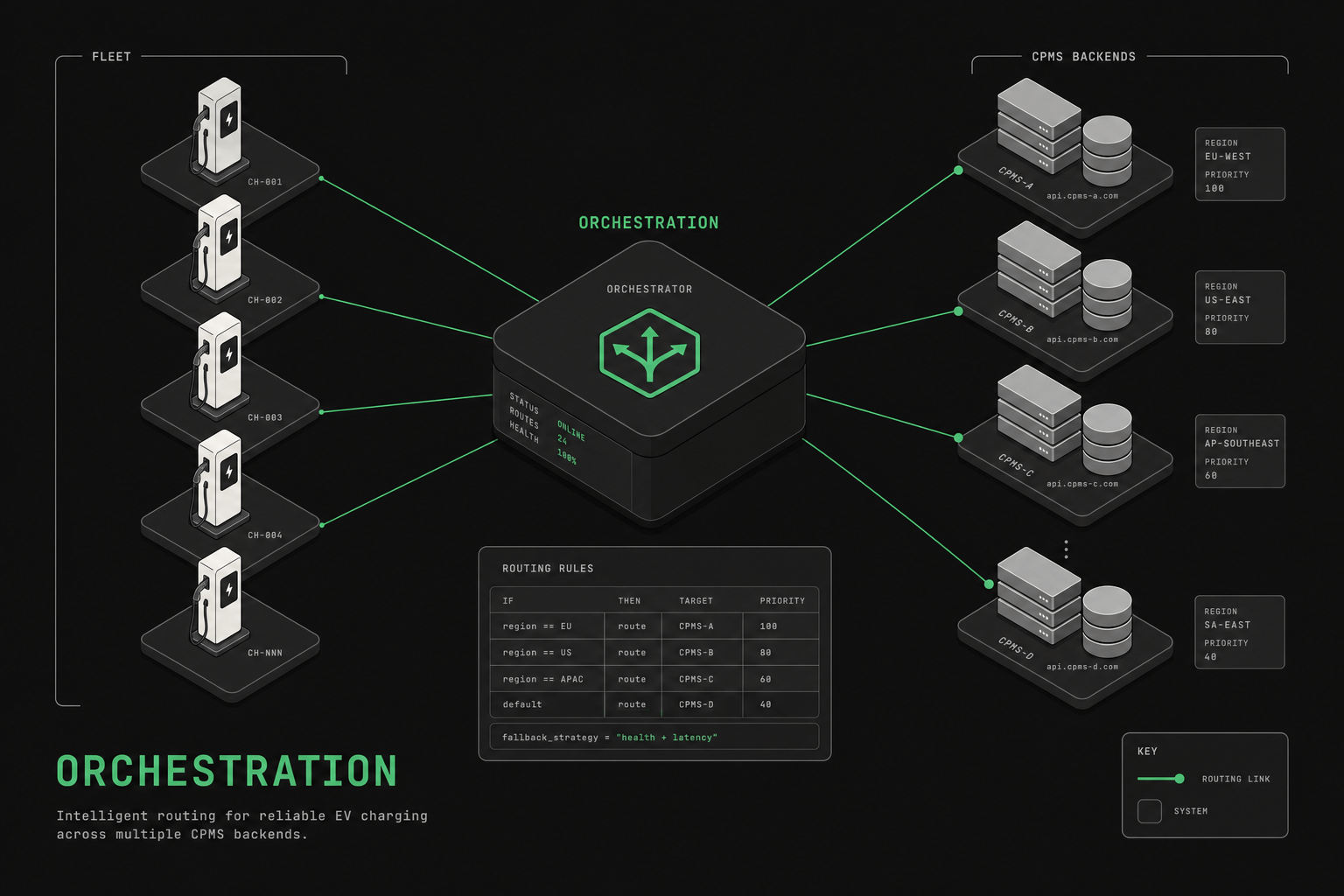
When some charger groups must move now and others later, a gateway sits between the fleet and multiple backends and routes by station, site, or vendor. That makes wave-based migration realistic instead of a single high-stakes cutover night. You can move one depot, watch the new CPMS handle real BootNotification, Heartbeat, and StartTransaction traffic, then expand. If a wave misbehaves, you re-point that group back to the old backend at the gateway rather than re-flashing endpoint URLs on hardware in the field. That rollback path is the single most common reason operators we talk to keep the gateway even after migration finishes.
Your fleet is mixed and interprets OCPP differently
Different charger vendors interpret OCPP differently in production, and the gaps are rarely in the spec, they are in the edges. One vendor sends MeterValues on a different cadence, another formats idTag casing inconsistently, a third reconnects aggressively after a dropped socket. A gateway normalizes that behavior so your business systems see one consistent event shape instead of a per-vendor exception list. The practical payoff: billing and analytics stop carrying vendor-specific branches, and a firmware update on one charger model stops breaking a downstream report.
You want to keep backend options open
Some teams want one system for charger operations and another for data, billing, or partner connectivity. A gateway preserves that flexibility instead of forcing a single backend relationship, and it lets OCPP for the chargers and OCPI for roaming live on separate contracts. If roaming is in scope, the OCPI guide explains why that separation matters for CDR and token flows.
Your current CPMS is your only data source
If the existing CPMS is also your only source of session or event data, a gateway can create a stable event layer before you attempt the platform replacement. You capture raw OCPP frames at the boundary, so analytics and reconciliation keep working through the cutover even when the backend underneath is changing.
When can you skip the gateway entirely?
Skip the gateway when the migration is genuinely simple: a greenfield or single-vendor fleet, few downstream integrations, and tolerance for a direct cutover without parallel operations. In those cases the extra layer adds latency and an operational surface without removing risk that exists.
The point is not to add architecture for its own sake. A gateway you do not need still has to be patched, monitored, scaled, and kept on the critical path of every charging session. That is real operational weight. We have seen teams add a gateway "to be safe" on a uniform 1.6 fleet and then spend the first quarter debugging the layer itself rather than the migration it was meant to de-risk.
A useful filter: if you cannot name two distinct backends, two charger vendors, or two migration waves, you probably do not need the gateway yet. Add it the moment any of those becomes true, because retrofitting a gateway under live traffic is harder than starting with one.
Gateway vs direct CPMS replacement: how they compare
A direct replacement is faster to reason about but concentrates risk into a single cutover. A gateway spreads that risk across waves at the cost of one more layer to operate. The table below maps the trade-offs operators weigh most often.
| Factor | Direct CPMS replacement | OCPP gateway, then replace |
|---|---|---|
| Migration style | Single big-bang cutover | Phased, wave-by-wave |
| Rollback | Re-flash endpoint URLs on hardware | Re-point a group at the gateway |
| Mixed-vendor fleets | Backend handles every quirk | Gateway normalizes before backend |
| Multi-backend routing | Not possible mid-migration | Native, route by site or vendor |
| Data continuity | Tied to backend availability | Raw events captured at the boundary |
| Added latency | None | One WebSocket hop |
| Operational surface | Lower | Higher, the layer needs care |
| Best fit | Uniform greenfield fleets | Mixed fleets, live cutovers |
Read the table as a risk dial, not a verdict. The more rows where your situation sits in the right-hand column, the stronger the case for staging a gateway first. For a structured architecture read alongside this, start with the OCPP gateway and OCPP proxy landings.
A worked example: migrating a mixed three-vendor depot fleet
A gateway turns a high-risk single-night CPMS swap into a sequence of reversible, site-by-site waves. Here is how that plays out in practice. Picture a regional CPO running roughly three charger vendors across a dozen sites, fed by an aging CSMS that also owns billing exports and a single OCPI roaming link. Marketing wants no downtime, finance wants billing continuity, and one vendor's firmware reconnects so aggressively it floods the backend on every deploy. A direct swap would force all three problems to resolve on the same night.
With a gateway in front, the rollout sequences cleanly. First, point every charger's OCPP WebSocket at the gateway, no backend change yet, and confirm the existing CSMS still sees normal BootNotification and MeterValues traffic through the new hop. Second, migrate one quiet site to the new CPMS by changing a routing rule, while the gateway keeps absorbing the noisy vendor's reconnect storms and smoothing idTag casing so billing exports stay consistent. Third, capture raw frames at the boundary so finance can reconcile sessions independently of which backend served them.
If a wave regresses, you re-point that site to the old CSMS at the gateway and investigate without touching field hardware. Roaming stays on its own OCPI contract the whole time, so a backend issue never takes down partner sessions. The big-bang night becomes a sequence of reversible steps. That reversibility, more than any single feature, is what we have found separates calm migrations from war-room ones. For the full sequencing playbook, see our dedicated legacy CSMS migration plan for CPOs.
What a useful gateway should provide
A useful gateway does more than proxy traffic, it owns normalization, routing, observability, and rollback. If a product only forwards frames and leaves migration, data, and failure handling unresolved, the architecture gain is small and you are paying latency for nothing.
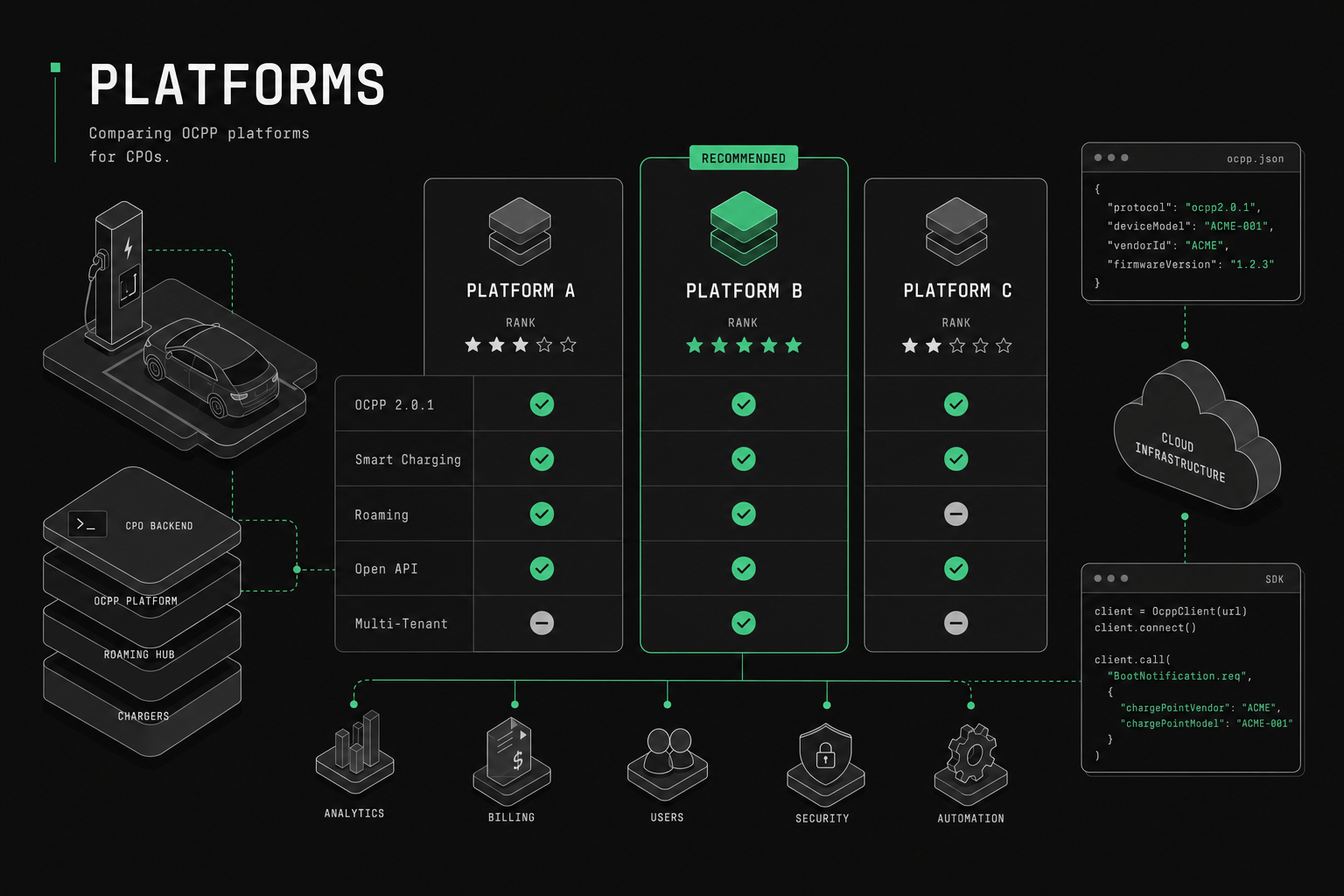
Look for OCPP 1.6 and 2.0.1 support so a fleet spanning both versions sits behind one layer. Look for charger normalization that flattens vendor quirks, multi-backend routing by site or vendor, observability with access to raw OCPP events rather than a summarized dashboard, safe rollback during migration, and stable data export for analytics or billing. The observability point matters more than buyers expect: when a wave goes wrong, the team that can read the actual frames at the boundary diagnoses it in minutes, while the team stuck with a backend's filtered logs spends the night guessing. A gateway that hides the protocol is a gateway working against you.
What commercial leverage does a gateway create?
Commercially, a gateway shifts a big-bang replacement into a modular rollout, which changes your negotiating position with full-suite vendors. It reduces pressure to commit everything to one platform on day one and can shorten time to a real pilot.
It preserves negotiating leverage because you are no longer locked into a single backend's timeline or feature roadmap, you can run a credible alternative in parallel and let results decide. That does not make a gateway automatically cheaper. The honest framing: compare its cost against avoided migration risk, reduced service disruption, and long-term flexibility, not against zero. When a botched cutover means refunding sessions and fielding support tickets, the gateway's cost often looks small next to the disruption it prevents. For how that flexibility maps to platform selection, pair this with pricing and a side-by-side comparison of platforms.
Where ev-cloud fits
ev-cloud is built for this exact problem: an open OCPP infrastructure layer that lets operators modernize without rewriting the whole stack at once. It is most useful when you need multi-backend routing during transition, protocol-level control over a mixed charger fleet, stronger data ownership, and clean separation between field connectivity and commercial systems.
If your next question is rollout sequencing, start with the legacy CSMS migration plan for CPOs. If you are moving toward vendor selection, combine this with the OCPP buyer guide. To talk through a specific fleet, get in touch.